
After working on many software projects, I have noticed a common pattern. Founders usually do not come with too few ideas. They come with too many.
The first version may start with a simple business concept, but very quickly the feature list grows. Payments are added. Then notifications. Multiple user roles. Reporting. Chat. Admin dashboards. AI features. Third-party integrations. Advanced settings. Meanwhile, the original budget and expected delivery date often remain unchanged.
This is usually where the real purpose of an MVP starts getting lost.
An MVP should not be a smaller copy of everything you eventually want your product to become. It should be the smallest reliable product that can prove whether the core idea works.
Current product guidance supports this approach. Atlassian describes an MVP around one target user, one primary problem, one core workflow and only the features necessary to test that value. CB Insights' 2026 analysis of hundreds of failed startups also found poor product-market fit among the most common underlying causes of failure.
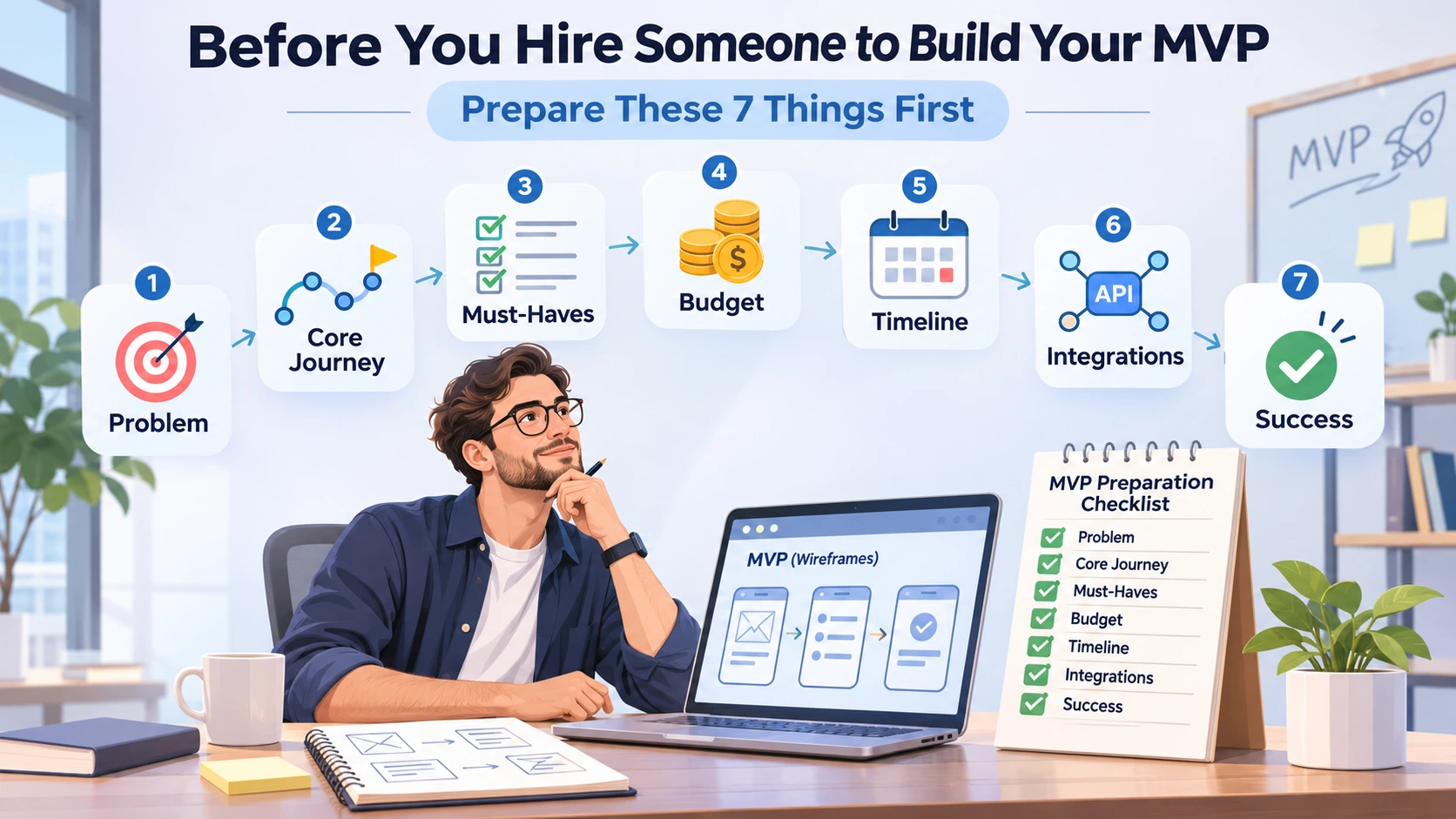
So before hiring a development team, I believe founders should prepare seven things. You do not need a complete technical specification. A good software partner should help you turn business requirements into workflows, architecture and technical decisions. But the clearer you are about the business problem, the better the development process usually becomes.
1. Be Clear About the Problem Before Listing Features
A product should start with a problem, not a feature list.
Before discussing technology, ask:
- Who has this problem?
- What are they doing today?
- What makes the current process difficult?
- Why would they change to your product?
For example, saying: "We need a mobile app with notifications, payments and AI." does not tell the development team much about the real product.
A better starting point is: "Our customers currently spend several hours coordinating this process manually. We want them to complete it from one place without calling different people." Now we have a business problem. Features can be designed around that problem instead of being added because competitors have them or because they sound useful.
Stripe's current startup guidance makes a similar point: founders should validate the problem and the customer before investing heavily in the product.
Technology should support the business idea. It should not become the business idea.
2. Define the Core User Journey
Before deciding what belongs in version one, define the most important journey a user must be able to complete.
For a marketplace, it might be: Search for a service, select a provider, place an order and receive confirmation.
For a healthcare platform: Find a doctor, request an appointment and receive confirmation.
For a training platform: Select a training scenario, complete the session and receive useful feedback.
There may eventually be dozens of workflows, but an MVP should have a clear primary journey. This is also how I personally think about the success of a first version.
The first sign of a successful MVP is that the intended user can complete the core journey reliably from beginning to end.
If that journey does not work properly, metrics such as adoption, retention or user feedback become secondary. You first need a product capable of consistently delivering its core value.
3. Separate Core Features From the Wish List
One of the most difficult conversations during MVP planning is deciding which features should wait. This becomes particularly important when the budget is limited.
My approach is usually to look at the client's available budget and identify the functionality required to deliver the core idea. Then we separate everything else.
A useful question is: If we remove this feature, can the user still complete the main journey and experience the product's core value?
If the answer is yes, the feature may belong in a future phase. That does not mean the idea is bad. It simply becomes part of the wish list.
If the MVP gains users and proves commercial potential, those features can be developed with much more confidence because the business is now investing in something the market has started validating.
The alternative is trying to build the founder's entire long-term vision before knowing whether users want the core product. That is rarely the best use of a limited startup budget.
4. Align the Scope With the Available Budget
Founders often ask how much an MVP should cost. There is no universal answer because a marketplace, healthcare platform, AI application and simple internal business tool are very different products.
The more useful discussion is: What valuable version of this product can we realistically build within the available budget?
If the budget cannot support every requested feature, there are two reasonable options.
- Increase the budget.
- Or reduce the first version to its essential scope.
What I do not recommend is pretending every feature can simply be squeezed into the same budget. That usually creates pressure somewhere else.
- Testing gets reduced.
- Important edge cases get ignored.
- Architecture becomes rushed.
- User experience suffers.
- Or the project runs beyond its original estimate anyway.
A smaller MVP that performs its core job well is usually more useful than a larger MVP where many features are only partially complete.
5. Understand the Relationship Between Scope, Time and Resources
Budget is not the only constraint. Founders often arrive with a fixed scope and a fixed deadline at the same time.
Sometimes there is a genuine business reason for the deadline. A funding presentation, pilot customer, industry event or contractual opportunity may create a real launch date. In those situations, the project needs to be planned around the constraint.
Depending on the product, that might mean reducing the first release, dividing the work into phases or adding resources where parallel development genuinely helps.
But one principle remains important: Budget, scope and time are connected. If one is fixed, at least one of the others usually needs some flexibility.
Adding more developers is not always the answer either. Some development work depends on previous decisions or modules being completed first. Throwing more people at tightly connected tasks can sometimes create more coordination rather than more speed. A realistic development plan should identify what can safely happen in parallel and what cannot.
6. Identify Integrations Before the Estimate Is Finalized
This is one area founders often underestimate. A requirement may initially sound simple:
- "We also need payments."
- "We want SMS notifications."
- "It should connect to our CRM."
- "We will probably use an AI assistant."
- "We need Google Maps."
Each statement may introduce an external system that has its own API, authentication, pricing, limitations, approval process and failure cases.
Integrations can include:
- payment gateways,
- email and SMS providers,
- CRM or ERP systems,
- maps and location services,
- AI APIs,
- accounting software,
- social login,
- analytics platforms,
- IoT devices,
- existing company databases,
- and third-party industry platforms.
These do not automatically make a project expensive. But they should be known early.
For example, integrating an established payment provider into a standard checkout flow is very different from building a product where payments are divided between multiple parties, refunds follow custom business rules and transaction history must reconcile with another system.
An integration is not just another button on the screen. It can affect the architecture behind the product.
Tell your development partner about every external system the MVP may need to communicate with before the final scope and estimate are agreed.
7. Decide What Version One Is Supposed to Prove
Many founders know what they want to build but have not clearly defined what they expect to learn from version one. That is worth deciding before development begins.
An MVP may be trying to prove:
- that customers will use a new workflow,
- that people will pay for the service,
- that a manual process can be automated,
- that a marketplace can connect two groups successfully,
- or that a technical idea works reliably enough to become a commercial product.
Atlassian recommends treating the MVP as a way to test a specific assumption rather than simply as the first release of a large roadmap.
I agree with that approach. For me, though, the first practical milestone is even simpler. Can the target user reliably complete the core journey the product was created to provide?
Once that works, you can start learning from real users.
- Which features do they request?
- Where do they struggle?
- Do they return?
- Does the product save them time?
- Are they willing to pay?
- Which assumptions were wrong?
Those answers should influence phase two much more than the original wish list.
You Do Not Need to Have Everything Figured Out
There is another mistake I would not want founders to make after reading this. You do not need to arrive at your first development discussion with a 100-page specification. In fact, that can sometimes create its own problems.
What you should bring is clarity about the business.
- Know the problem.
- Know who experiences it.
- Understand the main journey.
- Know your approximate budget.
- Share the deadline if one exists.
- Mention every external system you know the product will need.
- And be open about which ideas are essential and which are still experimental.
A good software partner should help with the rest.
- They should challenge unnecessary features.
- They should identify missing workflows.
- They should explain technical trade-offs.
- They should help turn business requirements into a realistic first version.
The developer's job should not simply be to convert a feature list into code. Especially during an MVP, part of the value should come from helping the founder decide what is worth building first.
An MVP Is a Learning Investment
CB Insights' 2026 analysis of startup failures found that poor product-market fit remained one of the most common underlying problems.
That is exactly why an MVP exists. You are trying to learn before investing in the complete product.
The best MVP is therefore not the one with the largest feature list. It is the one that gives the business the clearest useful answer.
- Did we solve the right problem?
- Can the customer complete the main journey?
- Does the product deliver enough value for us to continue?
If those answers are positive, the wish list becomes much more interesting. Now you are no longer adding features to an assumption.
You are improving a product that has started proving itself.
If you are planning an MVP and are unsure what belongs in version one, the most useful first discussion may not be about technology at all. It may simply be about the business problem, the user journey, the available budget and what the first release actually needs to prove.

