AI Virtual Receptionist
Answer approved business questions, capture why the caller is contacting you, route the conversation, and make human assistance available.
Digital Sensei designs Voice AI systems that handle real business conversations—connecting telephony, speech recognition, conversational AI, backend workflows, natural voice responses, and human handoff in one operational system.
A useful AI phone agent needs to understand who is calling, why they called, what context is available, what it may say or do, and when a person should take over.
The value comes from connecting the conversation to the business process—not simply connecting a model to a phone number.
Each use case needs its own conversation boundaries, business context, permitted actions, exception paths, and handoff rules.
Answer approved business questions, capture why the caller is contacting you, route the conversation, and make human assistance available.
Gather requirements, check the defined business workflow, initiate supported booking actions, and confirm the appropriate next step.
Ask structured questions, collect relevant context, categorize needs, and route suitable opportunities into the next business step.
Guide callers through approved information, collect the details a team needs, and trigger a defined follow-up workflow.
Use caller intent and workflow rules to direct calls, escalate exceptions, or transfer when human assistance is appropriate.
Create guided conversational practice, scenario-based interactions, coaching workflows, and useful performance feedback within a product.
HeyLibby is direct Voice AI delivery proof. Synqro.ai shows conversational voice technology integrated into a broader SaaS training, coaching, and reporting experience.
A 24/7 AI voice agent and virtual receptionist built to handle live phone conversations, answer business and service questions, gather caller requirements, support booking and lead qualification workflows, provide multilingual voice workflows, and hand calls to people when appropriate.
Its delivered conversational workflow brings together Twilio Media Streams, OpenAI / ChatGPT, Deepgram speech-to-text, and ElevenLabs text-to-speech around business actions rather than treating speech as a standalone feature.
Twilio • OpenAI • Deepgram • ElevenLabs • Voice Workflows
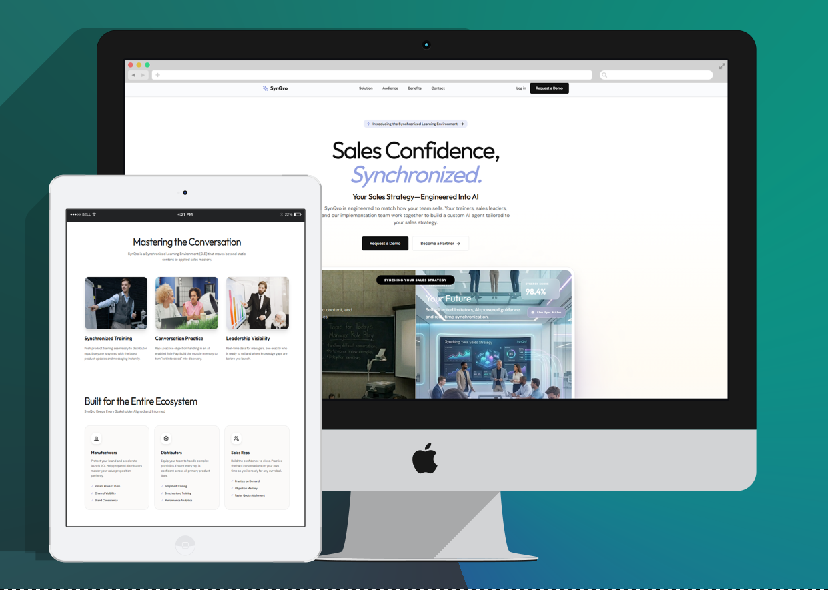
An AI sales training and enablement SaaS with conversational practice, scenario-based coaching workflows, readiness and performance visibility, and reporting. Retell AI voice integration works within the wider backend, API, and product architecture.
Voice AI • Retell AI • Conversational Training • SaaS • APIs
HeyLibby demonstrates a live AI phone agent across telephony, speech, conversation, action, and handoff. Synqro.ai demonstrates voice conversation as a capability inside a larger SaaS product.
Explore more Digital Sensei case studiesThis is an example architecture pattern, not a mandatory provider stack. The exact services and boundaries should follow language, latency, voice quality, integration, cost, and operational requirements.
Twilio or a suitable voice platform receives or places the call.
Real-time audio and call context enter the conversational workflow.
Deepgram or an appropriate STT service turns speech into usable input.
OpenAI / ChatGPT or a suitable model interprets context and forms a response.
Node.js or NestJS coordinates APIs, context, validation, rules, booking, qualification, and routing.
ElevenLabs or an appropriate TTS service returns a natural voice response to the caller.
Good conversational design takes more than a system prompt. It defines what the AI needs to understand, ask, verify, do, and communicate at each stage.
These technologies reflect delivered project experience, not formal vendor partnerships or a claim that one provider is universally best.
Twilio and Twilio Media Streams support live phone and audio-stream workflows in HeyLibby. Synqro.ai has verified Retell AI integration for conversational training.
Speech-to-text integration turns caller audio into input the conversational system and its application workflow can use.
Conversation logic can use approved context and defined boundaries while backend code retains control of business actions.
Text-to-speech integration converts the system response into a natural voice returned through the call workflow.
Backend services coordinate context, validation, application rules, integrations, and structured call outcomes.
Appropriate data stores can support approved business context, workflow state, reporting inputs, and product requirements.
Provider selection depends on language requirements, latency needs, voice quality, product workflow, integration requirements, cost, and operational constraints.
Voice AI becomes operationally useful when the call can securely pass structured information into the software where work happens.
An AI phone agent should have a clear operating scope and escalation path. It does not need to replace staff or pretend certainty when the conversation belongs with a person.
A transfer path can consider an unsupported request, an uncertain system state, a high-value conversation, an exception, or a caller who wants a person. The precise triggers and available transfer options are defined for the solution.
A focused voice workflow can be connected to an existing SaaS platform, web application, Node.js or NestJS backend, admin portal, booking system, custom software product, or business system where suitable APIs exist.
Every existing system still needs assessment. Integration can often be incremental: understand the current system → define the voice workflow → specify backend actions → connect and test real calls → deploy and improve.
Each stage keeps the phone experience connected to real callers, business rules, supporting systems, handoff needs, and production constraints.
Understand callers, objectives, call types, existing systems, constraints, and escalation requirements.
Define intents, questions, context, actions, outcomes, boundaries, and handoff rules.
Select telephony, speech, AI, backend, data, and integration components around the workflow.
Connect call handling, conversational behavior, backend workflows, and external systems.
Test expected calls, unclear input, interruptions, failures, escalation paths, and edge cases.
Release the system, observe the workflow, and refine conversations and integrations over time.
Voice AI commonly needs deliberate improvement after launch. Support can be fixed-term, ongoing, or flexible-resource based depending on the product and operating model.
Voice systems work best when the conversation, phone channel, backend, integrations, human operations, and ongoing product needs are designed together.
We begin with the caller, business purpose, required information, permitted actions, outcomes, and exceptions.
HeyLibby and Synqro.ai provide verified experience across live phone workflows, conversational training, and product integration.
Telephony and AI are connected to APIs, data, validation, routing, booking, qualification, and business rules.
Transfer, escalation, uncertainty, exception paths, and caller preference are treated as design requirements.
Senior technical involvement can span discovery, architecture, implementation, QA, deployment, and evolution.
Support can adapt conversations, integrations, backend behavior, providers, and features as operating needs change.
Digital agencies and technology partners can also engage Digital Sensei when additional Voice AI, telephony or conversational-integration capability is required.
A Voice AI agent is software that participates in spoken conversations and can connect speech recognition, conversational AI, voice synthesis, business context, backend actions, and human handoff.
Yes. HeyLibby is verified delivery experience for a 24/7 AI voice agent and virtual receptionist handling business questions, requirement gathering, booking, qualification, multilingual voice workflows, and human handoff.
Yes. An inbound agent can receive calls through a telephony platform, understand speech, use approved business context, respond by voice, trigger supported actions, and transfer when needed.
Suitable telephony systems can technically support outbound calls. The exact use case, calling rules, consent requirements, workflow, and human oversight need to be assessed before implementation.
Yes, when a supported booking workflow or API is available. The agent can gather requirements, validate the required information, initiate the defined action, and communicate the next step.
Yes. A call can gather structured information, ask defined questions, categorize the caller's needs, and route the resulting opportunity into an approved follow-up process.
Yes. Human handoff can be designed for caller preference, unsupported requests, exceptions, uncertainty, high-value conversations, or any other defined escalation rule.
Yes. HeyLibby uses Twilio Media Streams as part of its live AI voice workflow, and Digital Sensei also provides dedicated Twilio contact-center development services.
Twilio Media Streams can stream call audio between Twilio and an application in real time, enabling speech recognition, conversational processing, and generated voice responses within the call flow.
Yes. HeyLibby provides verified experience with Deepgram for speech-to-text and ElevenLabs for text-to-speech within a live Voice AI workflow.
Yes, where the system exposes suitable integration points. Backend APIs can provide approved context and control actions such as data capture, booking, routing, notifications, and follow-up.
Yes, when the selected speech, conversational, and voice services support the required languages and the conversation is designed and tested for them. HeyLibby includes verified multilingual voice workflows.
Yes. Synqro.ai demonstrates voice and conversational integration within a wider SaaS workflow. Any existing platform first needs assessment of its APIs, data, permissions, and product architecture.
Testing covers expected calls as well as unclear speech, interruptions, missing context, invalid data, provider or integration failures, caller requests, escalation, and other relevant edge cases.
Yes. Support can include troubleshooting, conversation and context refinement, routing changes, new scenarios, backend and integration updates, provider changes, and continued product evolution.
Share the call workflow, business process, or existing system you want to connect. Digital Sensei can help design the conversation, architecture, integrations, business actions, and handoff path.