
A few years ago, showing an AI system answering a phone call was impressive by itself.
Today, that is no longer enough.
The more important question is whether the AI can answer a real customer, understand why they are calling, collect the right information, perform a useful action, and know when it should transfer the conversation to a human.
That change is important because Voice AI is moving from interesting demonstrations into real business workflows.
The technology has improved, but that is only part of the story
Voice AI depends on several things happening very quickly.
The system needs to understand what the caller says, decide how to respond, generate a natural voice, and continue the conversation without uncomfortable pauses.
That used to be one of the biggest problems.
Twilio now reports median latency below half a second for its Conversation Relay platform. More importantly, Twilio said in April 2026 that developers had already processed millions of minutes through Conversation Relay since its general availability release. That is a useful indication that Voice AI is moving beyond prototypes into production workloads.
Readers interested in the technical side can review Twilio Conversation Relay.
Voice models themselves are improving as well. In May 2026, OpenAI introduced GPT-Realtime-2 with GPT-5-class reasoning for real-time voice applications, along with new real-time transcription and translation capabilities.
The significance is not simply that AI voices sound better. The complete conversation is becoming faster, more natural and more capable.
Small businesses have a very practical problem
Consider a dental clinic.
Someone calls while the receptionist is already speaking with a patient.
Another person calls after the clinic has closed.
A third caller only wants to know whether the clinic performs root canal treatment and whether an appointment is available this week.
None of these conversations necessarily requires an employee to spend several minutes on the phone.
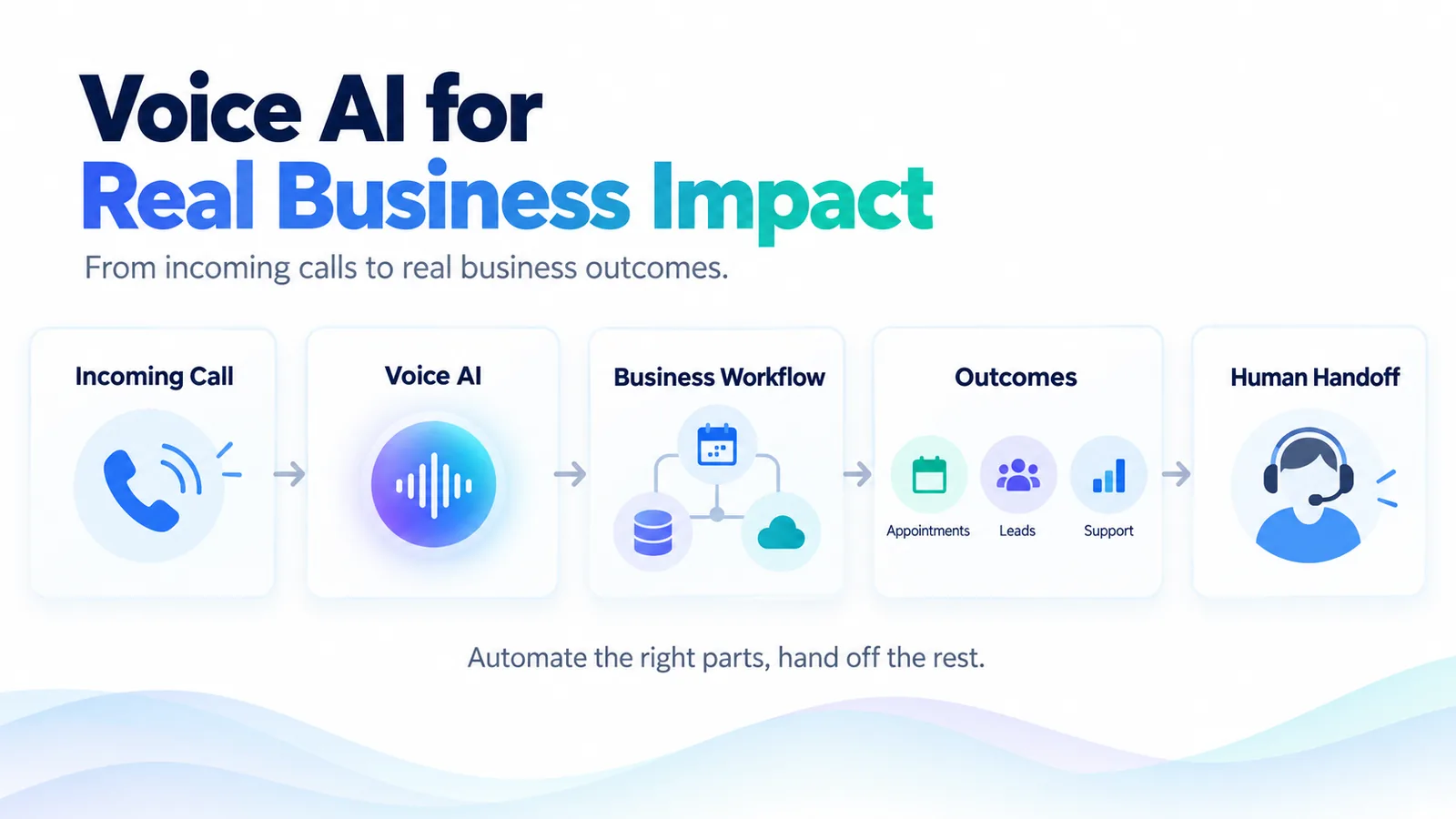
A properly designed Voice AI system can handle the initial conversation, answer approved questions, collect caller information, check availability through another system, arrange an appointment or prepare the request for the staff.
The same idea applies to law firms, property businesses, home-service companies, repair services, healthcare practices and many other businesses that depend heavily on incoming calls.
This is where I believe Voice AI becomes interesting for small businesses. It does not need to replace the receptionist. It can remove repetitive calls from the receptionist's workload.
A useful Voice AI agent is connected to the business
This is also where many Voice AI demonstrations become misleading.
A chatbot that can speak is not automatically a useful receptionist.
A production system needs to understand the business workflow behind the conversation.
If somebody calls a dental practice and asks for an appointment, the AI needs to know more than dentistry. It may need access to services, opening hours, appointment availability and rules about what information it can provide.
If a caller wants to change an existing booking, the system must identify the correct booking before taking action.
If the caller has an unusual medical question, complains about previous treatment or simply asks to speak with someone, the AI should know when to stop automating.
The intelligence is therefore not only inside the language model.
A large part of the intelligence is in the business rules surrounding it.
This is why I normally think about the business process before thinking about which AI model should be used.
My experience building this type of system
I have seen this directly while working on HeyLibby, a conversational Voice AI solution designed around small-business call handling.
The system combines telephony through Twilio with speech recognition, an AI language model and natural speech generation. The important part, however, is not simply connecting those technologies.
The real work is defining what should happen during the conversation.
What information should the agent collect?
Which questions can it answer safely?
When should it perform an action?
What happens when it does not understand the caller?
When should a human take over?
How should interruptions be handled?
These questions have much more impact on the final customer experience than simply changing one language model for another.
Twilio's production guidance reflects many of the same concerns, including interruption handling, language switching, error handling, speech recognition quality and observability.
Human handoff is not a failure
I believe one of the biggest mistakes in Voice AI is trying to automate every call.
There are conversations that a business should want a human to handle.
A customer may be angry.
The request may be unusual.
The conversation may involve a sensitive decision.
The AI may simply be uncertain.
A good Voice AI system should recognize those situations and make the handoff easy.
Twilio itself now highlights live-agent escalation as part of production conversational AI rather than treating it as an exception.
The goal should therefore not be:
How can AI answer every call?
A better question is:
Which parts of this call can AI handle reliably, and where does human judgment add more value?
Voice AI can now perform actions, not just answer questions
This is the development that makes the technology commercially interesting.
A voice agent can potentially connect to calendars, CRM systems, internal databases, ticketing platforms, messaging services and custom business software.
That means a conversation can produce an outcome.
A lead can be captured.
An appointment can be scheduled.
A service request can be created.
Customer information can be collected.
A confirmation can be sent.
A complicated inquiry can be routed to the correct employee with the context already captured.
This turns Voice AI from a talking FAQ into part of the operating workflow.
Production Voice AI is still not easy
The technology becoming practical does not mean implementation has become trivial.
Real callers interrupt.
They change their minds halfway through sentences.
They speak with different accents.
They call from noisy environments.
They provide phone numbers and addresses that must be understood correctly.
Network delays happen.
External APIs fail.
AI models occasionally misunderstand what was asked.
OpenAI's engineering discussion of real-time voice systems highlights how sensitive the experience is to latency, jitter, connection quality and interruption handling.
This is why there remains a large difference between creating an impressive Voice AI demonstration and building a dependable Voice AI product.
Where I think small businesses should start
I would not begin by asking AI to run the complete customer-service operation.
I would identify one repetitive and measurable workflow.
For a dental practice, that might be answering common questions and collecting appointment requests outside office hours.
For a home-service company, it might be capturing the caller's location, problem and preferred appointment time.
For a law firm, it might be collecting initial lead information before a human reviews the inquiry.
Once that workflow works reliably, additional responsibilities can be introduced gradually.
This approach reduces risk and gives the business something much more important than an AI demonstration.
It gives the business a measurable result.
Final thought
Voice AI has reached an interesting stage.
The question is no longer whether software can hold a telephone conversation.
It can.
The more valuable question is whether that conversation can be safely connected to a real business process and produce a useful outcome.
That is where I see the real opportunity for small businesses.
And it is also why I believe successful Voice AI projects will increasingly be designed around workflows, business rules and human handoff, rather than around the AI model alone.