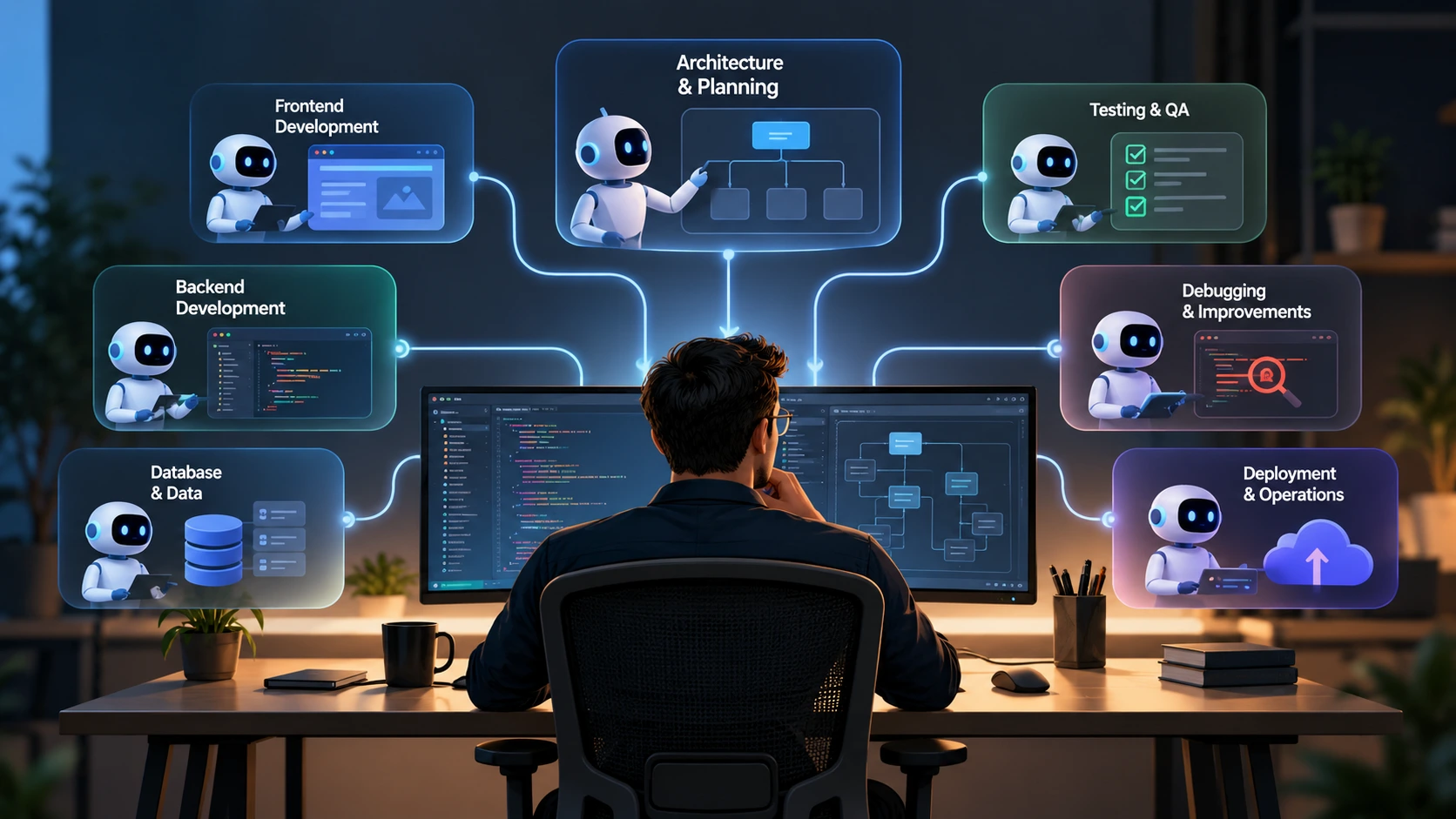

A few years ago, building a production SaaS application normally meant dividing the work across several people. Someone handled frontend development. Someone worked on the backend. Another person looked after the database. Testing, deployment and troubleshooting added more people and more time.
AI coding agents are starting to change that equation. I experienced this recently while building Synqro AI. I designed the system architecture first, then developed the complete frontend and backend, handled QA and testing, resolved issues, prepared the production environment and deployed the system live. The entire process took me around one and a half months.
I did not have another developer working alongside me. I did, however, have AI agents helping me throughout the development process. That experience changed the way I think about software development economics.
This was not simply asking AI to build an application
There is an important distinction here. I did not start with a blank prompt saying, “Build me a SaaS platform.” Before implementation started, I had already spent time understanding what the product needed to do and designing its architecture.
The frontend was built with React.js, TypeScript and shadcn/ui. The backend was built with NestJS. PostgreSQL was used for the database.
I had already made decisions about how different parts of the system should interact, where responsibilities should sit, how data should flow and how the application should behave. AI agents then became part of the execution process. That difference matters.
An AI coding agent can generate a large amount of code very quickly. It cannot automatically guarantee that the product being built solves the correct business problem.
Agentic coding is different from autocomplete
For several years, developers have had AI tools that suggest the next few lines of code. Agentic coding is a much bigger change. Modern AI coding agents can inspect a codebase, understand several files at once, plan a change, modify code, run commands, execute tests, investigate errors and iterate on the result.
OpenAI now describes Codex as capable of taking engineering work from an issue through to tested, review-ready code. GitHub’s Copilot cloud agent can research a codebase, create an implementation plan and then perform the work after the developer reviews that plan.
This changes the relationship between the engineer and the development environment. Instead of writing every line manually, I increasingly find myself describing what should happen, reviewing the proposed approach, checking implementation decisions and validating the final result.
The amount of typing goes down.
The amount of judgment does not.
How AI agents helped me build Synqro AI
While developing Synqro, I used AI-assisted and agentic coding throughout the project. One of the biggest advantages was speed of iteration.
Once I had defined how a feature should work, an AI agent could inspect the surrounding code, help implement the feature, update related parts and assist with testing. It was particularly useful when work touched several files.
That type of change traditionally involves moving between controllers, services, types, frontend components, API integrations and tests while mentally keeping the entire change in context. An AI agent can keep much of that context active while it works.
It was also valuable during debugging. Instead of manually tracing every error from the beginning, I could provide the problem, logs and relevant context, then let the agent investigate possible causes. I still had to decide whether its explanation made sense, but the investigation cycle became much faster.
The same applied to repetitive implementation work, refactoring, validation, frontend components and test preparation. Individually, none of these tasks sounds revolutionary. The difference appears when these small savings happen hundreds of times during a project.
The bottleneck starts moving
Traditional software development spends a significant amount of engineering time translating decisions into code. AI coding agents reduce the cost of that translation. That means another part of the process becomes more important.
Someone still needs to decide:
- What should the system actually do?
- How should the data be structured?
- Where should business rules live?
- What happens when something fails?
- Which actions require additional security?
- What should happen when two workflows interact?
- Which AI-generated solution is appropriate for this codebase?
- When should the agent’s suggestion be rejected completely?
These are not mainly coding questions. They are architecture, product and engineering judgment questions.
This is why I believe experienced engineers may actually gain more leverage from AI agents than inexperienced developers. The better you understand the system, the more precisely you can direct the agent.
Research is beginning to show the same pattern
The 2025 Stack Overflow Developer Survey found that 84% of respondents were already using or planning to use AI tools in their development process. Among developers using AI agents, 69% said agents had increased their productivity and around 70% said they had reduced the time required for specific development tasks.
But there is another important number. More developers said they distrusted AI accuracy than trusted it. That tells me something important. AI adoption does not remove the need for technical judgment. It increases the amount of generated work that someone needs to judge.
Anthropic reached an interesting conclusion from a privacy-preserving analysis of roughly 400,000 Claude Code sessions between October 2025 and April 2026. People generally made more of the planning decisions, while the AI agent made more of the execution decisions. Anthropic also found that users with greater domain expertise tended to achieve higher success and could get more work from the agent per instruction.
That closely matches my own experience. The clearer I was about the architecture and expected result, the more useful the agent became.
There are also reasons to be careful with productivity claims
AI development tools are moving so quickly that measurements can become outdated surprisingly fast. METR ran a controlled study with experienced open-source developers using early 2025 AI tools.
Unexpectedly, developers took around 19% longer when AI was available. That study attracted attention because developers themselves believed the tools had made them faster.
METR repeated the research with newer tools later in 2025. By February 2026, its results suggested that newer AI agents were probably creating more productivity benefit, but the researchers said they could no longer estimate the effect confidently because participation and task-selection effects made the newer results difficult to interpret.
I find this important because it prevents us from turning AI development into another hype story. The tools are powerful, but productivity depends heavily on the developer, task, codebase and workflow.
An interesting experiment inside OpenAI
OpenAI published another useful example in 2026. Its engineering team described building an internal software product where every line of repository code, including application code, tests, documentation, CI configuration and observability tooling, was generated by Codex. The team estimated that the product was created in roughly one tenth of the time it would have required through conventional development.
But the most interesting part of their write-up was not the amount of generated code. It was the change in the engineer’s role. Their engineers spent more time designing the environment, defining intent, creating feedback loops and enforcing architectural standards.
That is a much more meaningful description of agentic software engineering than simply saying, “AI writes code.”
AI is an amplifier, not automatically an improvement
Google’s DORA research describes AI in software development as an amplifier. I think that is one of the most accurate descriptions available today.
If the requirements are clear, architecture is sensible, tests are meaningful and engineering standards are strong, AI agents can amplify those strengths. If requirements are confused, architecture is weak and nobody is reviewing what gets generated, the same tools can produce technical debt at a much higher speed.
AI can help you build the correct product faster.
It can also help you build the wrong product faster.
The difference is usually not the model.
The difference is the person directing it.
Does this mean companies no longer need engineering teams?
I do not think that is the right conclusion. Complex products still require different skills, domain knowledge, design, security, infrastructure, QA, operations and collaboration.
What is changing is how much execution capacity one experienced person or a small senior team may have. A founder might previously have needed several developers to reach the first production version of a product. Today, under the right conditions, a smaller and more experienced team using AI coding agents may be able to reach the same milestone much faster.
That changes project economics. It changes MVP economics. It may also change what businesses should look for when hiring software teams.
The number of developers may become less important than the quality of the people defining the architecture, directing AI agents and accepting responsibility for what reaches production.
What my Synqro experience taught me
Building Synqro AI reinforced one principle for me:
AI works best when it is given direction, not responsibility.
I was comfortable allowing AI agents to generate and modify significant amounts of implementation because I knew what I expected the system to do. I could inspect the code. I could identify when the proposed implementation did not fit the architecture. I could test the result. And ultimately, I was responsible for deploying it into production.
That is very different from blindly accepting generated code. For me, agentic coding has not reduced the importance of software engineering experience. It has increased the value of that experience.
The economics of software development are changing
Coding itself is becoming cheaper. Turning a business requirement into hundreds of lines of implementation is becoming faster.
But understanding the business, designing the system, making architectural decisions, securing it, validating it and taking responsibility for production software still require judgment.
That may be where the real change is happening. The future software engineer may spend less time manually producing every line of code and more time designing systems, directing AI agents, reviewing decisions and controlling quality.
My experience building Synqro AI in around six weeks gave me a practical glimpse of that future. It did not feel like AI replacing a software engineer. It felt like one experienced engineer suddenly having significantly more execution capacity.
For founders and CTOs, that may be the more important question to explore:
Not, “How many developers can AI replace?”
But, “How much more can an experienced engineer or a focused senior team now deliver with AI agents?”